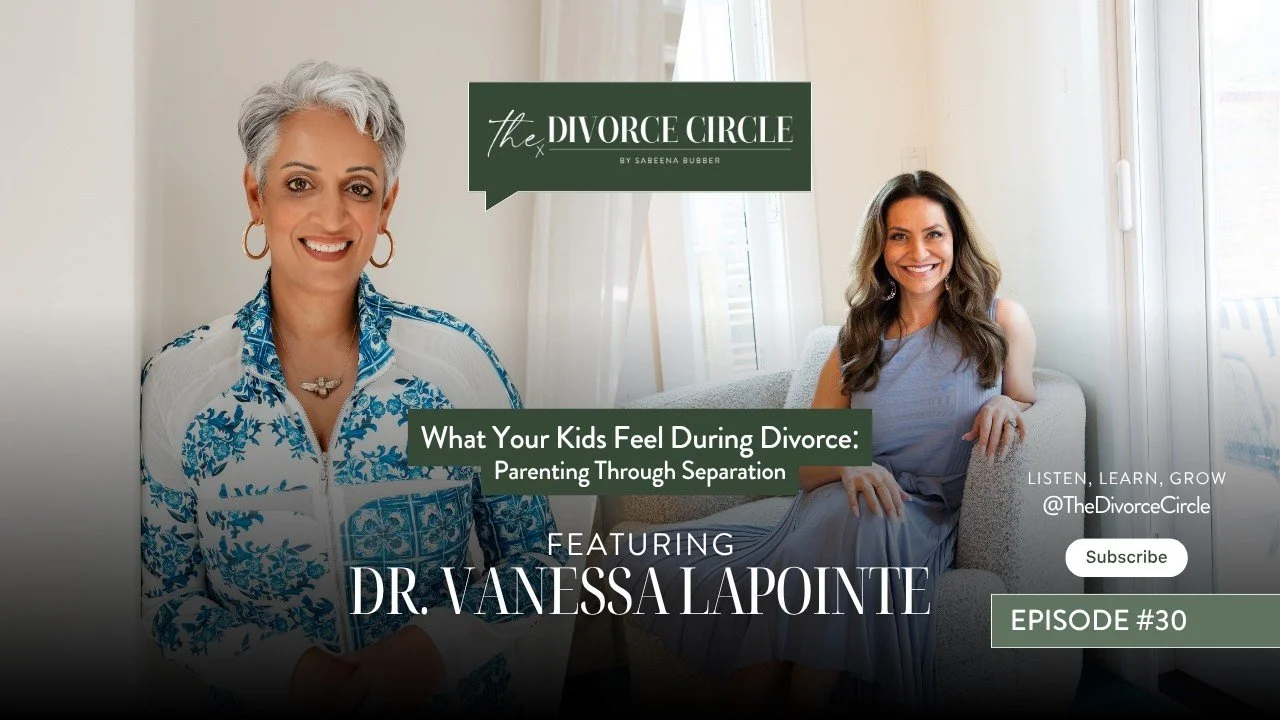
Episode #30: What Your Kids Feel During Divorce That They Don’t Say: A Child-Centred Guide for Parents
When parents separate, children often feel much more than they can explain. They may worry about what will change, whether both parents still love them, or whether they somehow caused the breakup. Instead of saying those things directly, they may become quiet, angry, clingy, anxious, distracted, or unusually focused on keeping everyone happy.
That is the central message of “What Your Kids Feel During Divorce That They Don’t Say,” a conversation on The Divorce Circle Podcast with Dr. Vanessa Lapointe, parenting educator, bestselling author, international speaker, and former practicing psychologist. Hosted by Sabeena Bubber, the episode explores how parents can look beneath a child’s behaviour, protect children from adult conflict, and create emotional safety while family life is changing.
Children do not need perfect parents during divorce. They need steady, emotionally available adults who can stay connected, tell the truth in age-appropriate ways, and protect them from problems that belong to adults.
What do children feel during divorce?
Children can experience grief, fear, anger, loyalty conflicts, confusion, sadness, relief, and uncertainty during separation. These feelings do not always appear as a clear conversation. A child may show them through a refusal to leave one parent, a drop in school performance, sleep changes, stomachaches, meltdowns, withdrawal, or repeated questions about the future.
A behaviour is not always a complete explanation of what is happening. It is often useful information. The parent’s job is not to interrogate the child or force a confession. It is to stay curious, calm, and connected enough that the child does not have to carry the feeling alone.
Every child and family is different. The ideas below are parenting guidance inspired by the episode, not a substitute for individualized mental-health, legal, or medical advice.
1. Look beneath the behaviour instead of labelling the child
A child who says “I don’t want to go” may be expressing fear, sadness, a need for control, difficulty with transitions, or concern about leaving the other parent. A child who becomes angry may be overwhelmed rather than simply defiant. A child who appears fine may still be working hard to manage feelings privately.
Before reacting, pause and ask yourself:
What might this behaviour be communicating?
What changed immediately before it happened?
Is this a pattern, or is it connected to a particular transition?
What would help my child feel safe enough to talk?
This does not mean excusing harmful behaviour or removing every boundary. It means separating the child’s need for support from the behaviour that needs guidance.
2. Remember that children read the emotional atmosphere
Children notice more than adults sometimes realize. They may hear an argument, sense tension during a handoff, notice a parent’s fear about money or housing, or feel pressure when adults ask them to take sides. Even when parents avoid direct conflict in front of them, children can be affected by the emotional energy around them.
A calm home is helpful, but parents do not have to hide every difficult emotion. A simple, honest statement can be more reassuring than pretending nothing is happening:
“I’m having a hard day, but this is an adult problem. You are safe, and you do not need to fix it.”
The goal is not to perform constant happiness. The goal is to keep adult burdens with adults.
3. Give children one dependable emotional anchor
During divorce, children may feel as though the rules, routines, and relationships around them are shifting. One steady relationship can make a meaningful difference. That relationship may be with a parent, grandparent, teacher, counsellor, coach, or another trusted adult.
Being a dependable adult does not require having perfect answers. It means following through, listening without rushing, making room for difficult feelings, and returning to connection after a hard moment. Consistency communicates: “You are still important to me, and I am still here.”
4. Do not make children responsible for adult problems
Children should not have to carry messages, gather information, manage a parent’s emotions, report on the other household, or choose which parent deserves their loyalty. They should also not be asked to keep secrets that create fear or responsibility.
Try to keep conversations about legal, financial, and relationship issues between the adults and appropriate professionals. When children ask questions, answer honestly but briefly, using language they can understand. Avoid details that are emotionally heavy or unnecessary for their age.
A useful response might be:
“Your other parent and I are working out grown-up decisions. You did not cause this, and it is not your job to solve it. We both love you, and you can love both of us.”
5. Help children name feelings without forcing them to talk
Some children talk freely. Others communicate through play, drawings, physical complaints, jokes, silence, or changes in routine. “How are you feeling?” may be too broad, especially when a child does not yet have the words.
Parents can make conversation easier by using specific observations:
“You were quiet after the handoff today. What was that moment like for you?”
“You seem worried about sleeping at the other house. What part feels hardest?”
“Would you rather talk, draw, or sit together for a while?”
Listen for understanding, not for evidence against the other parent. If a child shares something upsetting, resist the urge to immediately correct, defend, investigate, or promise a solution. Start with connection: “That sounds really hard. I’m glad you told me.”
6. Avoid treating resilience as a reason to minimize distress
Children can adapt. But resilience does not mean that change is painless, or that every child will adjust on the same timetable. Saying “kids are resilient” can become unhelpful when it leads adults to dismiss ongoing fear, sadness, anger, or confusion.
A more useful question is: What support would help this particular child adapt?
That may include predictable schedules, visual calendars, regular one-on-one time, school communication, age-appropriate explanations, family counselling, or additional support during transitions. It may also mean revisiting an arrangement that is creating repeated distress, with guidance from qualified professionals where appropriate.
7. Make two-home life as predictable as possible
Moving between homes can be tiring even when both homes are loving. Children may worry about forgotten clothing, schoolwork, devices, medications, comfort objects, pets, or missing an important event. Predictability lowers the number of decisions they have to make while they are already managing a major change.
Parents can help by coordinating practical details, keeping routines reasonably consistent, and using a calendar that the child can understand. Give advance notice when plans change. Let children keep meaningful belongings in both homes when possible, rather than making every transition feel like packing up their life.
Parents do not have to run identical households. Children can adapt to different rules and routines when the adults provide clarity, safety, and freedom from loyalty pressure.
8. Repair when things go wrong
Divorce is stressful, and parents will sometimes lose patience, miss a handoff, speak too sharply, or say more than they intended. A mistake does not have to define the relationship. Repair is a parenting skill.
A repair can be simple:
“I raised my voice, and that may have felt scary. That was my responsibility. You did not cause it. I’m sorry, and I’m going to try again.”
The parent does not need to ask the child to comfort them or say that everything is fine. The purpose is to restore safety and show the child that adults can take responsibility without making the child carry the emotional weight.
9. Watch for patterns and get support when needed
Parents know their children best, but divorce can make it difficult to interpret changes. Pay attention to patterns over time, especially persistent changes in sleep, appetite, school participation, friendships, mood, physical complaints, self-esteem, or willingness to move between homes.
If you are concerned, speak with a qualified child or family mental-health professional, your child’s physician, or the school’s support team. If a child talks about self-harm, feeling unsafe, or being harmed by someone else, seek urgent professional help in your area.
A child’s distress is not automatically proof that one parent is responsible, and a child’s calm appearance is not proof that no support is needed. The most helpful response is careful listening, appropriate assessment, and protection from adult conflict.
What should parents say to children during divorce?
Children often need the same core messages repeated over time:
This is not your fault.
You did not cause the separation, and you cannot fix it.
You are allowed to love both parents.
Adults are responsible for adult decisions.
Your feelings are welcome, even when they are complicated.
We will tell you what is changing and help you understand what happens next.
You can ask questions more than once.
Do not promise that nothing will change if change is unavoidable. Instead, be clear about what is known, what is still being decided, and what will remain steady.
Watch the full episode with Dr. Vanessa Lapointe
The full 38-minute conversation is available here: What Your Kids Feel During Divorce That They Don’t Say.
Use the episode chapters to go directly to the discussion you need:
You can also learn more about Dr. Vanessa’s work in child development, parenting, books, courses, and speaking through her official website.
Divorce affects practical life, too
Children’s emotional safety is connected to the practical decisions surrounding separation. Housing, finances, parenting schedules, school logistics, and legal arrangements can all affect a family’s day-to-day stability.
For mortgage questions connected to separation—such as a spousal buyout, refinancing a jointly owned home, or assessing whether one person can qualify on a single income—visit Sabeena Bubber, Mortgage Broker with Xeva Mortgage. Sabeena’s official site provides information about mortgage planning and separation-and-divorce mortgage situations. Mortgage decisions should be reviewed with the appropriate legal and financial professionals before an agreement is finalized.
For broader support, tools, expert conversations, and resources for life during and after separation, visit The Divorce Circle. The Divorce Circle brings together guidance across parenting, emotional wellbeing, family law, finances, real estate, and mortgages for people navigating divorce in British Columbia and across Canada.
Frequently asked questions about children and divorce
-
There is no single experience for every child. Common challenges include uncertainty, conflict between parents, moving between homes, changes in routines, fear of losing a parent’s love, and feeling responsible for adult emotions. Children often cope better when adults provide predictable information, stable connection, and freedom from taking sides.
-
Look for persistent or significant changes in behaviour, sleep, appetite, school engagement, mood, friendships, physical complaints, or transitions between homes. A child may also become unusually responsible, withdrawn, angry, anxious, or eager to keep everyone happy. Patterns matter more than one difficult day.
-
You can show interest in your child’s experience, but avoid questioning that makes them feel like a messenger, spy, or witness for one parent. Ask open, neutral questions and focus on how the child felt. If there is a genuine safety concern, seek advice from an appropriate qualified professional rather than placing the investigative burden on the child.
-
Take the refusal seriously without immediately assuming the cause. Stay calm, listen for the child’s experience, and look for patterns around transitions. Depending on the circumstances, consult a qualified child therapist, parenting professional, lawyer, or other appropriate authority. Do not pressure a child to carry adult conflict or make unilateral decisions without understanding the legal and safety context.
-
Yes. Children can build secure, joyful lives after separation. Happiness does not require pretending that divorce was easy. It grows through safe relationships, honest age-appropriate communication, stable routines, support for feelings, and adults who keep children out of the middle.
-
Your child may not be able to explain everything they feel about divorce. That does not mean the feelings are absent. Watch with curiosity. Listen without turning the child into a source of evidence. Keep adult problems with adults. Offer steady connection, clear information, and room for complicated emotions.
A final reminder for parentsYour child may not be able to explain everything they feel about divorce. That does not mean the feelings are absent. Watch with curiosity. Listen without turning the child into a source of evidence. Keep adult problems with adults. Offer steady connection, clear information, and room for complicated emotions.
You will not handle every moment perfectly. What matters is your willingness to return, repair, and keep showing your child that their relationship with you is safe.