
Divorce doesn't just break a marriage; it often shatters your self-image. When the life you planned falls apart, it is common to feel fragmented, stuck in survival mode, and unable to trust yourself or others. Many high achievers try to speed through the pain, hoping to reach the "next thing" as quickly as possible. But what if rushing the process is exactly what keeps you stuck?
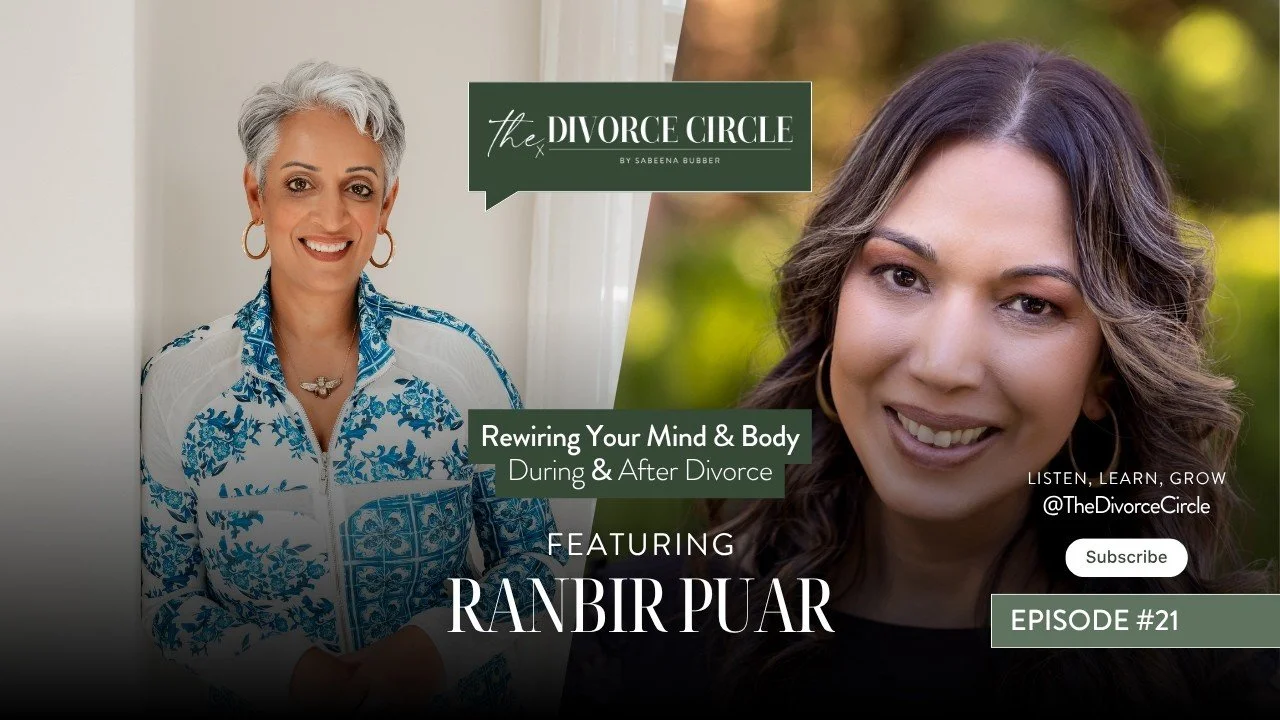
In a recent episode of The Divorce Circle Podcast, host Sabeena Bubber, Mortgage Broker at Xeva Mortgage sat down with Ranbir Puar, a clinical hypnotherapist, nervous system specialist, and founder of Pure Atma. Ranbir shared profound insights into why traditional talk therapy often falls short after a major life transition, and how somatic practices and hypnotherapy can help you rebuild your self-image from the ground up.
The Limits of "Top-Down" Healing
When navigating the trauma of separation, most people turn to coaching or talk therapy. While valuable, Ranbir explains that these are "top-down" approaches. They use the thinking mind to process ideas, which only utilizes about 5% of our brain power.
The other 95% of our programming is stored in the subconscious mind and the physical body. To truly heal, we need a "bottom-up" approach.
“You cannot force the subconscious to heal or change if the nervous system feels it is in danger. You must first establish a feeling of safety in the body.”
Referencing Dr. Stephen Porges' Polyvagal Theory, Ranbir notes that 80% of data travels from the body to the brain via the vagus nerve, not the other way around. If your body feels unsafe, your mind will remain in a state of anxiety, no matter how much you try to "think" your way out of it.
Hypnotherapy: Giving the "Monkey Mind" a Banana
Many people misunderstand clinical hypnotherapy, associating it with stage magic. Ranbir clarifies that it is actually a powerful tool for subconscious transformation.
Think of your conscious mind as a hyperactive monkey. Hypnotherapy simply gives that "monkey mind a banana" so it sits quietly on the bench. This allows the practitioner to speak directly to the subconscious to rewrite old, unhelpful codes and establish new patterns of safety and self-trust.
The Unicycle vs. The Bicycle: Mastering Independence
One of the most powerful metaphors Ranbir shared during the episode is the concept of the unicycle versus the bicycle.
You are a unicycle, and it is solely your responsibility to keep yourself upright. When you get into a relationship, you join with another unicycle to form a bicycle. If one person pulls too hard or stops pedaling, the bike crashes. After a divorce, the goal isn't to immediately find another unicycle to lean on; it is to master riding your own unicycle again.
The Old Way (Survival Mode): Rushing through the pain to get it over with.
The New Way (Empowerment): "Going wide" to the edges of your experience and feeling the depth of the pain.
The Old Way (Survival Mode): Breaking small promises to yourself (e.g., skipping a planned walk).
The New Way (Empowerment): Keeping small commitments to rebuild self-trust.
The Old Way (Survival Mode): Acting like a swimming pool, absorbing everything that jumps in.
The New Way (Empowerment): Acting like a trampoline, allowing things to hit, dip down, and bounce right back up (elasticity).
The Old Way (Survival Mode): Blaming the other person entirely.
The New Way (Empowerment): Asking, "What was my part in this?" to avoid repeating patterns.
Free Tools to Regulate Your Nervous System Today
You don't need an expensive retreat to start regulating your nervous system. Ranbir recommends several free, accessible tools:
The Body Scan: Imagine a grocery store barcode scanner slowly moving down your body. Notice where you are holding physical tension or stress without judgment.
Vagus Nerve Toning: Simple exercises like humming or gargling can stimulate the vagus nerve and bring the body back into a state of safety.
Anchoring: Create a physical touch (like pressing your hands together) or a visual cue that reminds your subconscious of a state of safety and calm.
Join The Divorce Circle Community
Navigating divorce is hard, but you don't have to do it alone. If you found this article helpful, please consider subscribing to The Divorce Circle on YouTube or following us wherever you listen to your podcasts.
Why does subscribing matter? Every follow, like, and review tells the algorithm that this content is valuable. Your support directly helps us reach and empower more women who are searching for guidance, clarity, and community during one of the toughest transitions of their lives.
To learn more about Ranbir Puar and her transformative work, visit Pure Atma. For expert mortgage and financial guidance from Sabeena Bubber, Xeva Mortgage during your separation, visit Sabeena Bubber's website.