
Episode #20: Part One: Why Divorce Court Is a Mistake for Most People (And What to Do Instead)
Why Divorce Court Is a Mistake for Most People (And What to Do Instead)
When a marriage ends, the default assumption for many people is that they need to hire an aggressive lawyer and prepare for battle in family court. Television and movies have conditioned us to believe that divorce is inherently a courtroom drama. However, the reality is that litigation is often the most destructive, expensive, and emotionally draining way to separate.
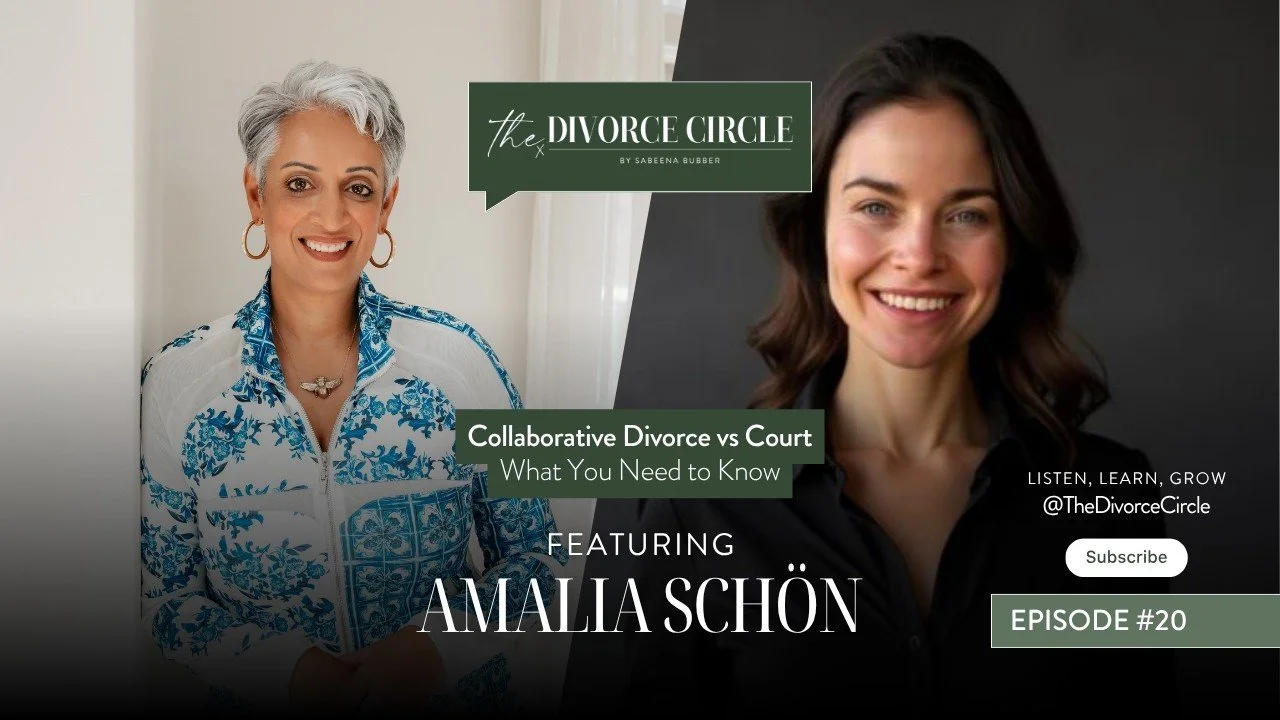
In a recent episode of The Divorce Circle Podcast, host Sabeena Bubber sat down with Amalia Schön, a North Vancouver-based family law lawyer, collaborative practitioner, and mediator at Schön Family Law. Amalia shared her professional journey away from traditional litigation and explained why the collaborative divorce process is a far superior alternative for most families.
The Hidden Costs of Divorce Litigation
Traditional divorce litigation is an adversarial process. It pits two spouses against each other in a win-lose scenario, often escalating conflict rather than resolving it. According to Amalia Schön, the damage caused by court battles extends far beyond legal fees.
“Litigation is incredibly expensive, lengthy, and emotionally harmful. It often leaves lasting negative impacts on both the parents and the children.”
When you enter the court system, you hand over the decision-making power regarding your finances, your assets, and your children to a judge who does not know your family. Furthermore, court records are public, meaning the intimate details of your financial and personal life become a matter of public record.
What Is Collaborative Divorce?
If court is a mistake, what is the alternative? The answer for many families is Collaborative Divorce.
Collaborative divorce is an out-of-court, team-based approach to separation. Instead of fighting over strict legal entitlements, the collaborative process focuses on the underlying interests and needs of both parties.
How the Collaborative Process Works
The collaborative process is highly structured to ensure safety, transparency, and forward momentum. Here is how it differs from traditional litigation:
The Goal
Traditional Litigation: To "win" based on strict legal positions.
Collaborative Divorce: To find mutually beneficial solutions based on family interests.
The Agreement
Traditional Litigation: Parties can threaten court at any time.
Collaborative Divorce: Both parties sign a "participation agreement" committing to stay out of court. If the process fails, both lawyers must resign.
The Meetings
Traditional Litigation: Lawyers communicate via formal letters and court filings.
Collaborative Divorce: Issues are resolved in "four-way meetings" involving both spouses and their respective collaborative lawyers.
The Team
Traditional Litigation: Each side hires their own competing experts (appraisers, psychologists).
Collaborative Divorce: The couple jointly hires neutral experts, such as financial specialists and divorce coaches, to assist the whole family.
The Role of the Divorce Team
One of the most powerful aspects of the collaborative process is the use of a multidisciplinary team. Lawyers are legal experts, but they are not financial planners or therapists.
In a collaborative divorce, you might work with a Divorce Coach (a mental health professional) to help manage the emotional volatility of the separation and create a sustainable parenting plan. You might also bring in a Financial Neutral to help untangle complex assets, value businesses, and project future financial needs. By using the right professional for the right job, the collaborative process is often more efficient and cost-effective than paying a lawyer's hourly rate to handle emotional or financial disputes.
The Danger of DIY Legal Agreements
While avoiding court is the goal, avoiding legal advice altogether is a dangerous mistake. Amalia strongly warns against using "Do-It-Yourself" templates, non-legal professionals, or AI tools like ChatGPT to draft separation or cohabitation agreements.
Family law is highly nuanced and varies significantly by jurisdiction. A poorly drafted agreement might save you a few thousand dollars today, but it can cost you tens or hundreds of thousands of dollars in the future if it is challenged or deemed invalid by a court.
Always get Independent Legal Advice (ILA) before signing any family law agreement. A lawyer trained in collaborative practice or mediation can review your agreement to ensure your rights are protected without unnecessarily escalating the conflict.
Key Takeaways for a Healthier Separation
If you are navigating a separation, keep these key insights from Amalia Schön in mind:
Prioritize Interests Over Positions: Focus on what you actually need to move forward (e.g., financial security, a stable home for the kids) rather than fighting over the letter of the law.
Protect the Children: Shield your children from the conflict. Never discuss legal issues with them or in front of them. Present a united, allied front as co-parents.
Have Hard Conversations Early: If you are entering a new relationship, consider a cohabitation or prenuptial agreement. Having difficult financial conversations early can prevent massive conflict down the line.
Choose the Right Professional: If you want an out-of-court settlement, hire a lawyer who is specifically trained in collaborative practice and mediation.
Join The Divorce Circle Community
Navigating divorce is hard, but you don't have to do it alone. If you found this article helpful, please consider subscribing to The Divorce Circle on YouTube or following us wherever you listen to your podcasts.
Why does subscribing matter? Every follow, like, and review tells the algorithm that this content is valuable. Your support directly helps us reach and empower more women and men who are searching for guidance, clarity, and community during one of the toughest transitions of their lives.
To learn more about Amalia Schön and her collaborative family law practice, visit Schön Family Law. For expert mortgage and financial guidance during your separation, visit Sabeena Bubber's website.