
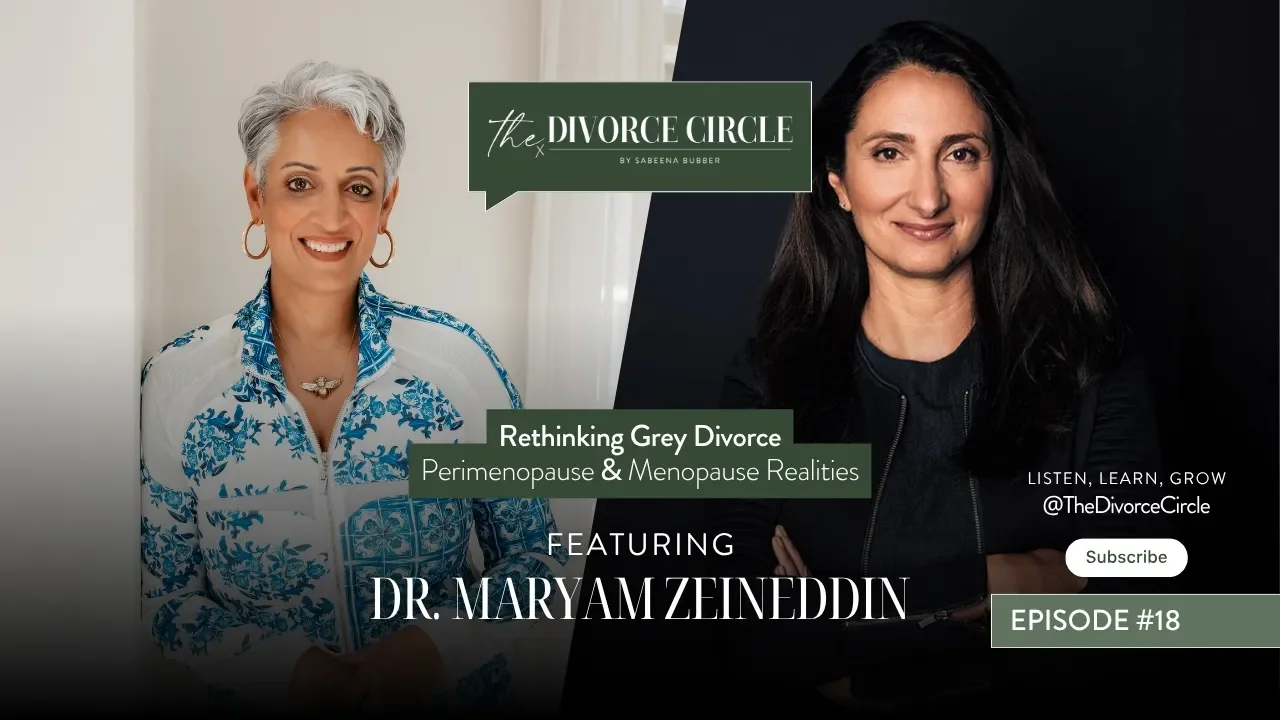
Episode #18: Why So Many Women Rethink Their Lives in Perimenopause & Menopause
-
A: Hormonal shifts during perimenopause and menopause — particularly declining estrogen and oxytocin — can heighten self-awareness and reduce a woman's tolerance for chronic stress. Many women in Canada find themselves re-evaluating long-term relationships during this time, not because menopause causes divorce, but because it creates the clarity to recognize when a relationship no longer serves their well-being.
-
A: Gray divorce refers to separations among couples aged 50 and over. In Canada, the gray divorce rate has increased significantly over the past three decades, with women over 50 being disproportionately affected financially and emotionally.
-
A: Chronic stress from separation and divorce can elevate inflammatory markers, suppress the immune system, and trigger negative genetic predispositions. For some women, the physical toll of staying in an unhealthy marriage can be more damaging than the process of leaving it.
-
A: Developed by Dr. Maryam Zeineddin of Zili CARE, the C.A.R.E. formula stands for: Calm the mind (meditation and mindfulness), Activate the body (strength training and cardio), Reinforce the body (proper nutrition, medical care, and HRT when appropriate), and Engage the soul (community, connection, and purposeful living).
-
A: The Divorce Circle, founded by Sabeena Bubber, offers a podcast, community, and expert resources for Canadians navigating separation and divorce. Visit www.divorcecircle.ca for legal, financial, and emotional guidance.
Why So Many Women Rethink Their Lives in Perimenopause & Menopause — And What It Means for Divorce in Canada
By Sabeena Bubber | The Divorce Circle Podcast
If you are a woman in your late 30s, 40s, or 50s and you have started to feel a quiet but persistent sense that something in your life needs to change — you are not alone, and you are not imagining it.
Across Canada, a growing number of women are making one of the most significant decisions of their lives during perimenopause and menopause: they are choosing to leave their marriages. This is not a trend driven by impulse or midlife crisis. It is a deeply physiological, emotional, and psychological shift that is reshaping how we understand both women's health and divorce in Canada.
In a recent episode of The Divorce Circle Podcast, I sat down with Dr. Maryam Zeineddin — a family physician with over 20 years of clinical experience, founder of Zili CARE, and one of the most compelling voices in Canadian preventative health — to unpack the real connection between hormonal changes, chronic stress, and the decision to separate.
What we discussed was nothing short of life changing.
The Rise of Gray Divorce in Canada
Canada's "gray divorce" rate — separations among couples aged 50 and over — has increased significantly over the past three decades. While the country's overall divorce rate has fluctuated, the rate among older Canadians has climbed steadily, and women are disproportionately affected.
The average age of divorce in Canada is now hovering around the late 40s to early 50s — right in the thick of perimenopause. This is not a coincidence.
Menopause Does Not Cause Divorce — But It Does Create Clarity
One of the most important reframes Dr. Zeineddin offered in our conversation is this: menopause does not cause divorce. It creates clarity.
Perimenopause is a transitional phase that can begin in a woman's late 30s and last 10 to 15 years. During this time, estrogen fluctuates wildly — what Dr. Zeineddin calls an "estrogen rollercoaster" — and oxytocin, the hormone associated with bonding and giving, begins to decline.
“Women lose the ability to endure chronic stress and hardship. They move out of survival mode. And for the first time, they start asking: do I want to spend the next 30 to 40 years of my life in a relationship that no longer serves me?””
This is not a breakdown. It is a biological awakening. And for many women navigating separation and divorce in Canada, understanding this distinction is the first step toward healing.
When Divorce Becomes a Health Issue
I shared something deeply personal in this episode — something I have not always spoken about publicly. I did not fully recognize that I needed to leave my marriage until my health was severely compromised by stage 4 endometriosis. The chronic stress of staying in a relationship that was no longer healthy for me had taken a physical toll I could no longer ignore. Even after my separation, I continued to live in a state of stress and then I went on to face a battle with breast cancer.
Dr. Zeineddin validated this experience with the science behind it. Chronic stress elevates inflammatory markers in the body, suppresses immune function, and can trigger negative genetic predispositions. For many women, staying in an unhealthy relationship is not just emotionally damaging — it is a medical risk.
She also explained how men and women often process stress differently. Men frequently default to "flight or freeze" — avoidance, tuning out, shutting down. Women often default to "fight" — becoming controlling, hyper-rationalizing, or desperately seeking emotional attunement. This polarization, layered on top of hormonal fluctuations and unresolved past traumas, can make conflict during midlife feel impossible to navigate.
The C.A.R.E. Formula: Rebuilding Your Health During and After Divorce
Through her work at Zili CARE, Dr. Zeineddin has developed a practical, evidence-informed framework for women who want to take ownership of their physical, emotional, and mental health — especially during major life transitions like separation and divorce.
She calls it the C.A.R.E. Formula:
C — Calm the Mind
What It Means: Formal or informal meditation; even 5-10 minutes of walking meditation or apps like Headspace
Why It Matters During Divorce: Slows brain waves, reduces cortisol, and helps you make clearer decisions during legal and financial negotiations
A — Activate the Body
What It Means: Strength training 2-3x per week; 150 minutes of moderate cardio weekly
Why It Matters During Divorce: Protects against osteoporosis and cardiovascular disease — the #1 killer of women — while boosting mood and resilience
R — Reinforce the Body
What It Means: Medical workups for fatigue (thyroid, iron, B12); supplements like Vitamin D3, Omega-3s, Magnesium; HRT when appropriate
Why It Matters During Divorce: Addresses the physical depletion that often accompanies chronic stress and hormonal shifts
E — Engage the Soul
What It Means: Community, volunteering, purposeful work, social prescribing (art, clubs, connection)
Why It Matters During Divorce: Combats the isolation that is one of the most dangerous side effects of divorce
Reframing Guilt: The Most Powerful Shift You Can Make
If you are a woman considering separation or in the middle of a divorce in Canada, guilt is likely a constant companion. You feel guilty for disrupting your family. Guilty for prioritizing yourself. Guilty for not trying harder.
Dr. Zeineddin's advice is both simple and profound: thank the guilt, then recognize it for what it is — someone else's expectation of you.
Women are socially conditioned to place everyone else's needs above their own. But when guilt arises around a decision that is genuinely right for your health and well-being, it is not a signal to stop. It is a signal that you are finally choosing yourself.
She also offered a powerful mental health practice: you are not your thoughts. When the voice in your head says "I am not enough" or "I am failing my children," recognize that you are not that voice. You are the awareness observing it. This distinction — between the thought and the thinker — is the foundation of healing.
Recognizing Burnout Before It Breaks You
Dr. Zeineddin outlined the key signs that your system is overwhelmed — signs that are especially common among women going through divorce in Canada:
Poor sleep and constant fatigue are the number one indicators that your nervous system is in crisis.
Over-functioning — doing everything for everyone while neglecting yourself.
Isolation — withdrawing from friends, family, and social situations.
Sensory overwhelm — avoiding loud environments, crowded spaces, or stimulating situations.
Obsessive control over exercise, diet, or routines as a coping mechanism.
If you recognize yourself in this list, please know: this is not weakness. This is your body asking for help. And help is available.
A Critical Gap in Canadian Women's Health Research
One of the most striking statistics Dr. Zeineddin shared is one that every Canadian woman deserves to know: only 6% of all research funding in Canada currently goes toward women's health research.
This means that the hormonal, physiological, and psychological experiences that are driving thousands of Canadian women to make life-altering decisions — including the decision to divorce — are still largely understudied and underserved by the medical system.
This is why platforms like Zili CARE and The Divorce Circle exist. Because women deserve better information, better support, and a community that truly understands what they are going through.
Watch the Full Episode
This conversation with Dr. Maryam Zeineddin is one of the most important episodes we have recorded on The Divorce Circle Podcast. Whether you are in the early stages of considering separation, in the middle of a divorce, or rebuilding your life on the other side — this episode is for you.
Resources & Links
The following trusted professionals and platforms are referenced in this episode and are available to support you:
The Divorce Circle — Events, education, and community for Canadians navigating separation and divorce www.divorcecircle.ca
The Divorce Circle Podcast — Listen to all episodes www.divorcecircle.ca/podcast
Sabeena Bubber — Mortgage broker, financial strategist, and founder of The Divorce Circle www.sabeenabubber.ca
Dr. Maryam Zeineddin — Family physician, health advocate, and founder of Zili CARE www.zilicare.com/founders
Zili CARE — Preventative health platform empowering women to take ownership of their well-being www.zilicare.com
Follow The Divorce Circle
Are you going through a separation or divorce in Canada? You do not have to navigate this alone. Join our growing community of women and men who are rebuilding their lives with clarity, confidence, and support.
Website:www.divorcecircle.ca
Podcast: The Divorce Circle Podcast
Instagram: @thedivorcecircle
Frequently Asked Questions About Divorce in Canada
What is gray divorce and is it common in Canada?
Gray divorce refers to separations among couples aged 50 and over. In Canada, this rate has increased significantly over the past three decades, driven in part by shifting social norms, greater financial independence among women, and the clarity that often accompanies midlife hormonal transitions like menopause.
Does menopause cause divorce?
Menopause does not directly cause divorce, but the hormonal shifts associated with perimenopause and menopause — particularly declining estrogen and oxytocin — can heighten self-awareness and reduce a woman's tolerance for chronic stress. Many women describe this period as one of profound clarity about what they need and deserve in a relationship.
How does chronic stress from divorce affect women's health in Canada?
Chronic stress elevates inflammatory markers, suppresses immune function, and can trigger negative genetic predispositions. Women going through separation and divorce in Canada are at increased risk for cardiovascular disease, autoimmune conditions, and mental health challenges. Prioritizing preventative health care during this time is essential.
What resources are available for women going through divorce in Canada?
The Divorce Circle, founded by Sabeena Bubber, offers a podcast, community events, and expert resources covering legal, financial, and emotional aspects of divorce in Canada. Zili CARE, founded by Dr. Maryam Zeineddin, provides preventative health tools and insights specifically designed for women navigating major life transitions.
What is the C.A.R.E. formula for women going through divorce?
The C.A.R.E. formula, developed by Dr. Maryam Zeineddin of Zili CARE, stands for: Calm the mind, Activate the body, Reinforce the body, and Engage the soul. It is a practical, evidence-informed framework for rebuilding physical, emotional, and mental health during and after divorce.
The Divorce Circle is a platform dedicated to empowering women and men across British Columbia and Canada to navigate separation and divorce with clarity, confidence, and community. Our podcast, events, and resources cover legal guidance, financial planning, mortgage advice, mental health support, and more.
© The Divorce Circle | www.divorcecircle.ca